Bond Quality Production Continuity and Operating Costs

In filter manufacturing, the hot melt adhesive supply system is often treated as auxiliary equipment for adhesive application. Purchasing and production discussions tend to focus on tank capacity, heating power, or price. The relationship between adhesive delivery, product quality, and production rate often receives attention only after interrupted adhesive flow, inconsistent application amounts, or poor bonding occurs.

In practice, hot melt adhesive must be melted, conveyed, and applied before it reaches the bonding point at the right time. A mismatch between any of these stages and the adhesive or process can prevent an otherwise suitable adhesive from performing as intended. The purpose of selecting an appropriate supply system is to deliver adhesive continuously to the point of use in the condition required by the process, supporting consistent bonding and continuous production.

1 Consistent Adhesive Delivery Is Part of Bond Quality

Filter bonding performance depends on the adhesive, substrates, application conditions, assembly operations, and subsequent curing. A supply system cannot replace adhesive and substrate compatibility testing, but it is responsible for reproducing the validated application conditions in production.

For frame bonding, for example, gaps in the adhesive bead may leave parts of the contact surface inadequately covered. Variations in adhesive quantity may produce inconsistent bonds within the same batch. When securing filter media pleats, bead position and continuity must also suit the product structure and production sequence. An irregular bead may affect fixation. Excess adhesive may also encroach on the effective airflow area; the actual impact should be verified against the product design.

These problems cannot all be attributed to the adhesive. The temperature of the adhesive at the applicator head, the adequacy of the supply, and synchronization between application and product position all warrant inspection. A suitable supply system helps reduce variation at this stage, making it easier for process engineers to assess how materials and assembly conditions affect the bond.

The value of a supply system should therefore be assessed by more than its ability to dispense adhesive. It must also apply adhesive to the correct location as required throughout continuous production.

2 Continuous Production Requires Matching Average Supply to Peak Demand

A production line’s average adhesive consumption does not represent its demand at every moment. Intermittent application, simultaneous operation at multiple stations, and processes that complete an entire bead in a short time can create peak loads above the average.

For example, a process using 8 g per unit at 1,200 units per hour has an average consumption of 9.6 kg/h. However, if the adhesive for each unit must be applied within 1 second, demand at the point of application during dispensing is 8 g/s. Average consumption and dispensing flow rate describe different conditions and cannot be used interchangeably. This example does not represent the rated capacity of any specific model.

Selecting equipment solely on average consumption, without considering actual dispensing time and the number of points operating simultaneously, may expose limitations when line speed increases or several stations operate together. The line may have to slow down, wait longer, or rely on repeated manual adjustments to maintain production.

Storage capacity, melting capacity, and pumping capacity also serve different purposes. Having enough adhesive in the tank does not mean it can be melted in time. Adequate melting capacity does not guarantee that every applicator head receives the required supply after the adhesive passes through the hoses. A suitable system must relate all these stages to the actual production cycle.

This matching helps reduce constraints on production rate caused by adhesive supply, enabling the equipment to support production under agreed operating conditions. Actual continuous operating performance should still be verified using the intended adhesive and target production rate.

3 Matching the Adhesive and System Helps Maintain Processing Conditions

The processing condition of hot melt adhesive is affected by temperature and thermal history. Processing conditions should be established from the adhesive supplier’s technical documentation, with the adhesive’s condition assessed in the melter, heated hoses, and applicator heads.

A higher temperature setting is not necessarily better. Raising temperature arbitrarily to improve flow temporarily may take the process outside the adhesive’s permitted conditions. Insufficient temperature may also affect conveying and application. Problems should be analyzed in relation to the adhesive’s temperature–viscosity relationship, equipment condition, and demand at the application point.

Heating duration also matters. If the amount loaded greatly exceeds actual consumption, or if the line stops frequently, adhesive may remain heated for extended periods. The impact of oversized equipment depends on adhesive characteristics and operating practices. A reasonable configuration balances production buffering with adhesive turnover instead of simply pursuing a larger tank.

Reactive PUR requires specific consideration of moisture exposure, feed design, packaging format, and shutdown and cleaning procedures. A conventional tank system must not be assumed suitable for reactive PUR. Adhesive type and equipment design require separate review. PLM’s tank system product information also explicitly requires compatibility to be confirmed for each project.

Selecting a system compatible with the adhesive helps align melting, conveying, and shutdown management with a consistent set of process requirements, reducing reliance on temporary adjustments to address abnormalities.

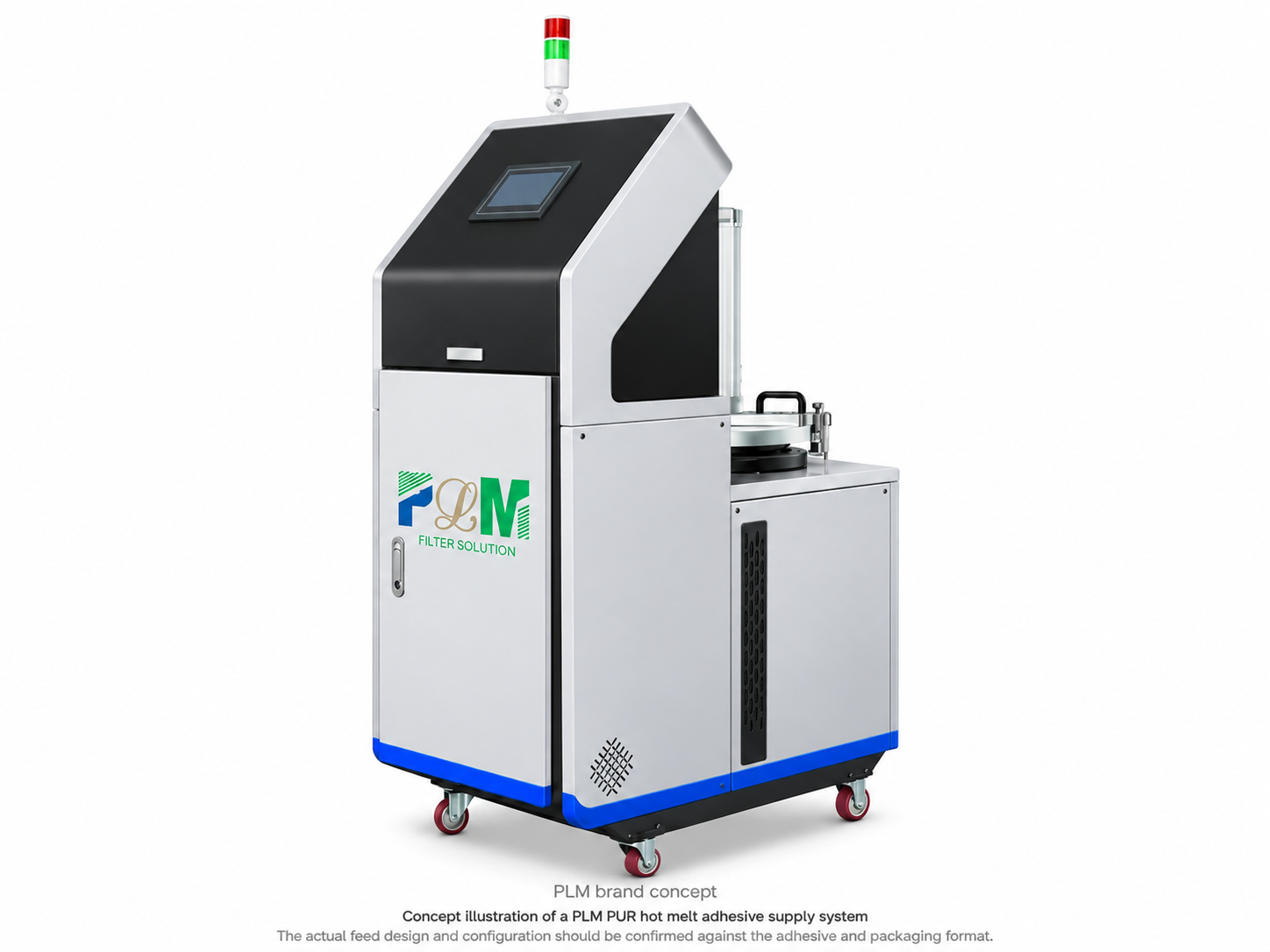
PLM PUR hot melt adhesive supply system.
4 Consistent Application Affects Material and Rework Costs

The cost of hot melt adhesive extends beyond its purchase price per kilogram. Adhesive applied per unit, production losses, cleaning consumables, rework, and scrap all affect the actual cost of adhesive use.

When application quantities are inconsistent, operators may increase the set amount to reduce the risk of localized adhesive shortages. Without measurement and validation, this adjustment may result in some products receiving more adhesive than the process requires. Excess application can also increase squeeze-out, cleaning, and cosmetic finishing work without necessarily improving bond performance.

An appropriate supply and application configuration provides the conditions needed to control the target adhesive quantity. Its value lies in helping establish a measurable process: first determine how much adhesive the product needs, then verify whether that amount can be maintained at the target production rate, instead of repeatedly adjusting settings based on the apparent bead thickness.

Cost evaluations can record adhesive consumption per acceptable product, adhesive used while resolving abnormalities, and the numbers of reworked and scrapped units. These data reveal more about the production impact of a supply solution than equipment price alone.

Whether adhesive use or rework can be reduced, and by how much, must be confirmed through production records under equivalent conditions. Percentage improvements cannot be promised solely on the basis of equipment configuration.

5 The Right Configuration Makes Multiple Stations Easier to Coordinate

A filter production line may have several adhesive application points, with different quantities, dispensing frequencies, and operating patterns at each station. Some stations run continuously while others operate intermittently; some dispense simultaneously while others alternate. The supply system must account for these differences.

The melter, pumps, heated hoses, and applicator heads affect one another. Hose length, adhesive viscosity at operating temperature, and applicator demand all influence evaluation of the complete solution. Simply adding more connections does not automatically meet the supply requirements of different stations.

Integration with automation is also important. Adhesive must be applied when the product reaches the specified position. Changes in line speed may require corresponding adjustments to application position or adhesive quantity per unit length. The solution should also define whether temperature status, run-permission signals, and alarms need to be integrated with the line controls.

A well-chosen configuration allows each station to follow the defined production sequence. Single or dual pumps and two or four connections are configuration options; their actual purpose and effectiveness depend on the operating conditions and control scheme.

6 Ease of Maintenance Affects Long Term Equipment Use

The value of a supply system is also reflected in everyday operation. Ease of refilling, access for hose inspection, and sufficient space for cleaning and maintenance all affect how easily operators can follow standard procedures.

If installation planning considers only the melter’s footprint and overlooks lid opening, refilling, and maintenance access, routine operations may become cumbersome. Poor hose routing may obstruct machine movement or make inspection more difficult. These problems may not be apparent when the equipment first dispenses adhesive, yet they can affect daily use over its service life.

Changeovers and shutdown management also need consideration. Cleaning methods may vary between adhesives, and procedures for reactive PUR in particular must be developed around both adhesive and equipment requirements. Clear operating procedures, suitable maintenance space, and necessary spare parts support help reduce trial and error when resolving problems.

Purchasing evaluations should therefore include installation, training, maintenance documentation, and the scope of spare parts support. A functioning melter is the starting point; consistent, correct operation by trained personnel helps sustain the required process conditions.

7 A Suitable System Helps Accommodate Product and Capacity Changes

Filter manufacturers may receive orders covering different sizes, structures, and material combinations. Product changes can alter bead length, adhesive consumption per unit, assembly time, and production rate. Equipment adaptability should therefore be discussed in relation to the actual product range.

If initial planning considers only one product without reviewing the models intended for production, later products may require different applicator heads, longer application times, or additional application points. Conversely, sizing an oversized system for an undefined expansion plan may increase investment and the burden of adhesive management.

A more useful approach is to define the main current operating conditions and the known range of variation, then assess which requirements can be met through configuration adjustments and which changes require additional accessories or renewed validation. This keeps equipment investment aligned with business plans.

Provision for expansion should be based on clear requirements. Support for a particular adhesive, application method, or additional stations must be checked against the actual configuration; it cannot be inferred directly from capacity or connection count.

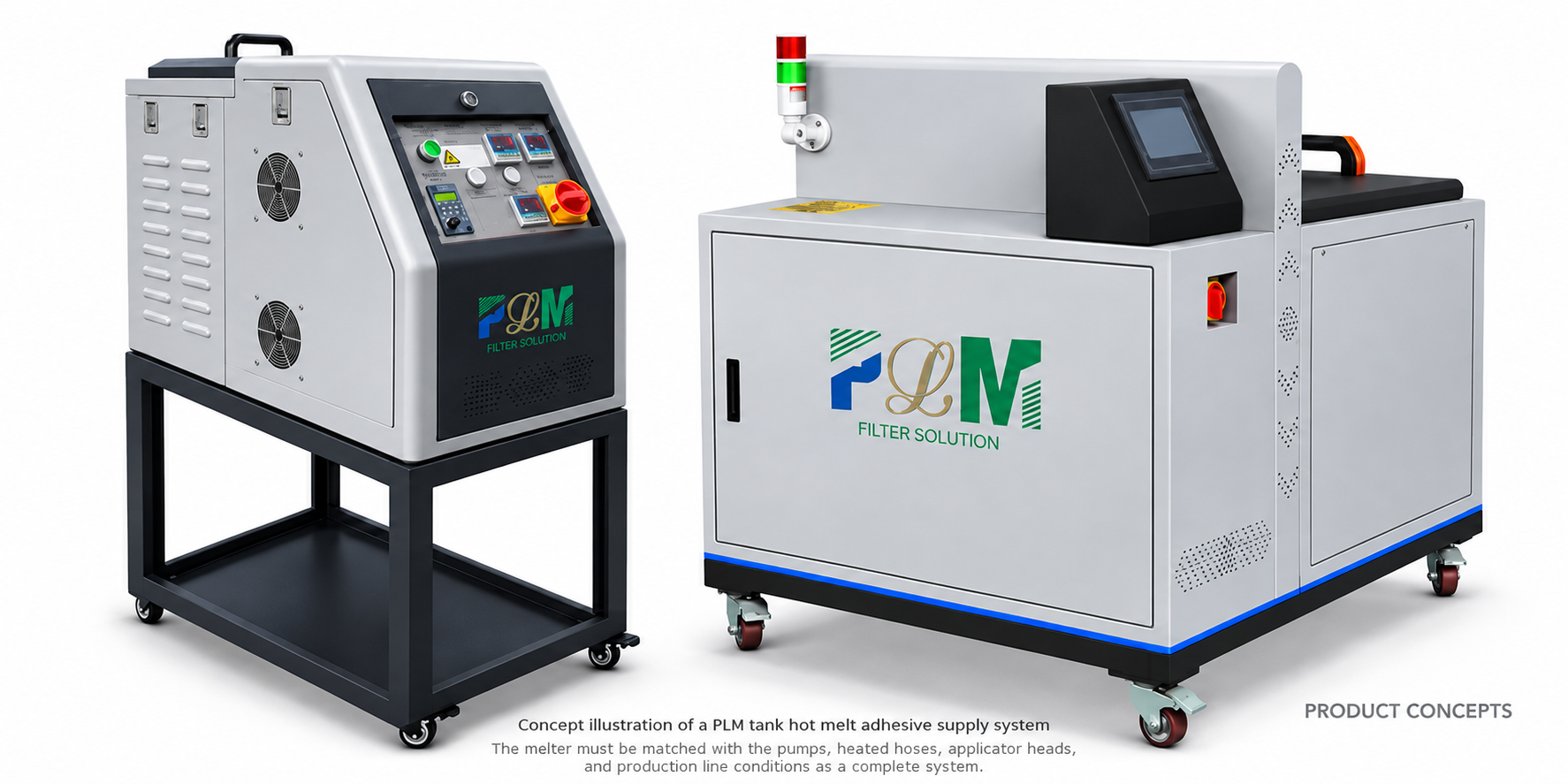
Two PLM tank hot melt adhesive supply systems.
8 Why Practical Validation Should Be Part of Purchasing

Compatibility between the adhesive supply system and the production line must ultimately be confirmed under actual operating conditions. Equipment specifications help guide configuration choices, but they cannot replace validation of the adhesive, substrates, and product together.

Trials should use the adhesive intended for production and representative samples. Observe dispensing during continuous and intermittent operation, simultaneous operation at multiple stations, and after refilling. Bond performance must also be evaluated under the specified pressing and curing conditions.

Acceptance should go beyond checking whether a bead is present. Adhesive quantity per unit, bead position, continuity, and bond test methods should correspond to product requirements and be agreed before the trial. For PUR, distinguish initial fixation from performance after curing under the specified conditions.

Over the longer term, this process also helps the factory establish initial process records. If abnormalities occur later, the validated adhesive, temperatures, production rate, and configuration provide a reference for identifying what has changed, instead of starting adjustments from scratch each time.

PLM Hot Melt Adhesive Supply Solutions for Filter Manufacturing

We offer PUR hot melt adhesive supply systems and a range of tank systems, including the PLM-PUR-20L, PLM-12L-E, PLM-20L, PLM-30L, and PLM-60L. Supply solutions can be configured according to adhesive characteristics, application demand, and production line layout.

For reactive PUR processes, we determine the feed design and operating requirements based on the adhesive grade, packaging format, and production conditions. For tank-based hot melt applications, we match capacity, pumps, heated hoses, and applicator heads to actual consumption and production rate, coordinating adhesive supply across the application stations.

Our focus extends beyond whether the equipment can dispense adhesive. We consider whether adhesive can reach the bonding point continuously, in the right condition and in the quantity required by the process. Through early process discussions, configuration assessment, and validation with actual adhesive and product samples, we help customers establish a reliable foundation for consistent bonding, continuous production, and routine maintenance.

Whether you are planning a new filter production line or seeking to address interrupted flow, inconsistent application quantities, or insufficient supply in an existing process, we welcome the opportunity to discuss your needs. With adhesive information, product samples, target capacity, and station layout, we can work with you to evaluate an appropriate hot melt adhesive supply solution.