How to Choose a HEPA Pleating Process for Your Filter Pack
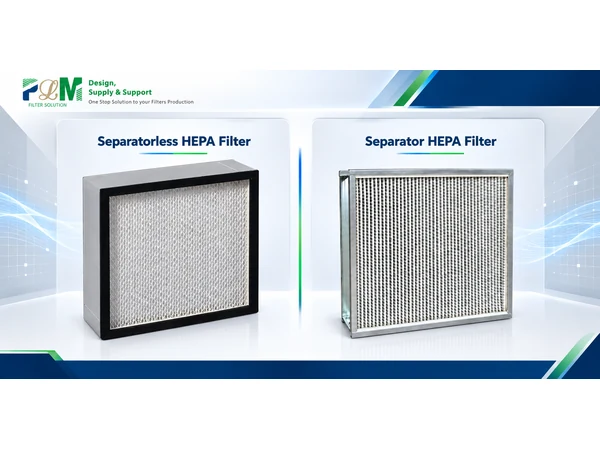
A suitable HEPA pleating route must form repeatable folds, keep the channels between them open and deliver a pack that fits the frame without damaging the media. Separatorless and separator constructions maintain that spacing in different ways, so the production route should follow the finished pack design. In the separatorless mini-pleat construction discussed here, hot-melt adhesive beads commonly support adjacent pleats. A separator construction uses a separate corrugated paper or aluminium sheet. Each approach places different demands on auxiliary materials, forming equipment, handling and assembly.
Define the Finished Pack Before Selecting Equipment
Start with the media grade, roll width, pack length, width and depth, pleat height and pitch, frame design, sealing method and acceptance requirements. A sample and a drawing show how these features connect more clearly than a machine model number alone.
Both routes include media forming and downstream finishing, but the spacing operations differ. Separatorless production coordinates folding with adhesive application and cooling. Separator construction adds corrugated-material preparation and insertion into the folded media. Define what must enter and leave each operation before comparing equipment.
The key interface in separatorless production is between pleat formation and hot-melt dispensing. Our PLPP-700-II intermittent gluing production line combines media pleating and hot-melt application for fiberglass or polypropylene, with downstream conveying and cooling arrangements. Its published functions help identify the equipment category; the material grade and working settings still require confirmation.
Evaluate adhesive compatibility, bead position, dispensing consistency, open time, cooling distance and cutting timing together. The adhesive must develop enough stability for the pack to retain the required pitch during cutting and transfer. Hot-melt setting in this stage is a cooling process; any later sealant curing follows the selected assembly material.
Inspect bead continuity and pack dimensions after cutting, then check them again after handling and framing. Excess adhesive can occupy usable media area or interfere with the channels. Insufficient support can allow pleats to shift. Establish the pattern and quantity through representative trials rather than increasing the amount by default.
Separator Construction Adds Corrugation and Insertion
For separator packs, media pleating and separator preparation are distinct operations that meet at pack assembly. The folded media must accept the specified spacer without tearing or becoming distorted. The corrugated separator must retain a profile that supports the intended air passages.
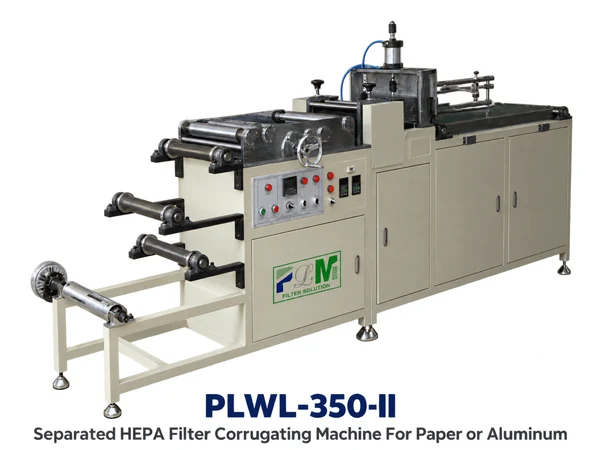
Our separator corrugating equipment range includes the PLZG-320 for paper corrugating and the PLWL-350-II, whose application description identifies aluminium-foil corrugation. Confirm the actual material, thickness, roller profile and edge treatment for the selected configuration.
Match the separator wave height and pitch with the media pleat geometry. Check feed stability, straightness, cut length and edge quality before insertion. An uneven profile or a sharp, misaligned edge can affect channel spacing or damage the media during assembly.
Where the product requires marking or secondary forming, define that operation separately. Having individual pleating and corrugating machines does not establish a complete line until their material-transfer and assembly interfaces have been confirmed.
Keep Channel Geometry Stable Through Handling
Pleat height and pitch establish the initial geometry, but the channels must also survive compression, squaring, transfer and framing. A tighter pitch can fit more media into a fixed space, while also narrowing the passages and making cooling or separator insertion harder to control. Select the geometry together with the airflow, resistance and manufacturing requirements.
Media mechanics also limit the useful operating window. Fiberglass media can be sensitive to concentrated tension, sharp bending and repeated contact. Polypropylene grades have different stiffness and thermal behaviour. Validate unwinding tension, contact pressure, web alignment and forming settings with the actual grade.
Record where and when dimensions are measured, including the condition after adhesive cooling or separator insertion. A machine's dimensional range is an initial screening value; it does not show whether a particular material can run at the nominal speed without cracks, stretching or pitch variation.
Qualify the Route with Actual Materials and Finished Filters
Trial the intended materials within the proposed operating window, including the selected lower and upper production settings. Measure pleat height, pitch, pack length, squareness and visible media damage. For the adhesive route, check bead position and dimensional recovery after cutting. For the separator route, check the corrugation profile, edge condition and insertion alignment.
Complete trimming, squaring, frame assembly, sealing and any applicable curing before final acceptance. A pack that is stable at the pleater or cutter may still change during later operations. Inspect the media-to-frame connection and the sealing interfaces specified by the product drawing.
Pleating equipment controls geometry; finished-filter classification depends on the complete construction and its test results. ISO 29463-1:2024 provides a classification and testing framework used with the related parts of the series. ISO 29463-4 addresses filter-element leakage testing. Apply the methods and acceptance criteria required by the chosen class and customer specification.
Keep results linked to the approved materials, settings and reference sample. Our filter testing and quality-control guide gives further context on connecting finished-product checks with manufacturing operations.
Match Materials, Product Mix and Maintenance to the Route
Separatorless production depends on adhesive compatibility, dispensing consistency and sufficient cooling before cutting. Confirm suitability for the material's thermal limits and the filter's service requirements. Separator production adds spacer selection, corrugation, edge handling and insertion. Evaluate moisture exposure, corrosion where relevant, particle shedding and deformation for the intended application.
Line planning should also account for model changes, material loading, access to rollers and adhesive components, trim removal and inspection before assembly. Record the tooling, guides and settings for each approved product family. Recipe storage supports repeatability when the incoming materials and equipment condition also remain controlled.
Inspect rollers, nozzles, knives, guides and sensors for wear or contamination. Published machine ranges help narrow the options, while actual output depends on the approved materials, batch mix and complete production route. Confirm the configuration with sample results before finalising the equipment scope.
Start with Samples, Drawings and Acceptance Requirements
For an initial HEPA pleating process review, prepare:
- Representative media, with grade, thickness, roll width and available technical data.
- A pack drawing or sample showing target dimensions, pleat height, pitch, frame and sealing design.
- The intended adhesive system or separator material, with relevant samples and specifications.
- Planned model range, output target, current equipment and applicable finished-filter acceptance requirements.
Share these details with PLM to review the spacing route, material trials and equipment interfaces together. The practical objective is a process that reproduces the approved pack geometry and meets the specified finished-filter checks.