Complete Filter Factory Solution for Stable and Efficient Production
A filter factory solution requires more than machines. It also depends on proper planning, process matching, customization, and operator support to achieve stable production. In many projects, problems emerge after the equipment arrives: the layout restricts material flow, the process does not match the target product, molds are not prepared for actual sizes, or operators lack proper training. Addressing these issues only after installation can delay production for months.
We help customers identify and resolve these issues before installation. Rather than treating a production line as a simple equipment list, we evaluate the product plan, capacity target, factory space, process route, mold requirements, and training needs together. This ensures that every machine has a clear role and each process connects smoothly with the next.
Budget Planning: Match Investment to Production Capacity
A common mistake is to choose machines before defining production targets. Even factories producing similar filters may require different equipment depending on whether they are testing a new market or preparing for daily batch production. We first clarify the initial product range, required output, automation level, and upgrades that can be deferred until orders stabilize. This helps avoid both overinvestment and insufficient capacity. Overinvestment ties up capital in unnecessary functions, while underinvestment creates bottlenecks from the start. Our budget planning aligns the equipment configuration with the customer’s current production stage, ensuring that the investment translates into practical production capacity.
Factory Layout Planning: Improve Material Flow and Efficiency
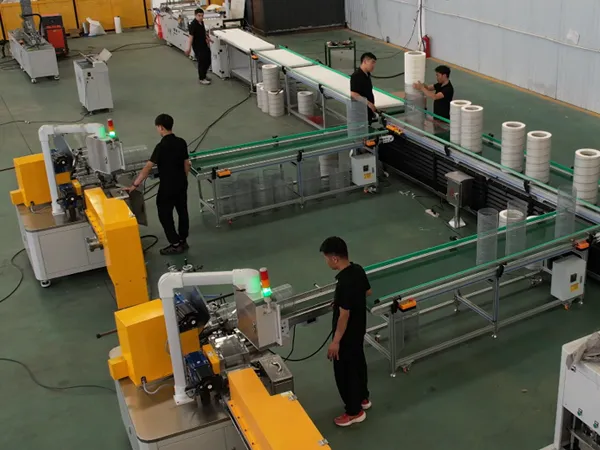
Factory layout is often treated as a secondary issue, but it has a direct impact on daily efficiency. Filter production involves filter media, end caps, adhesives, inner and outer mesh, semi-finished products, testing, packing, and storage. Without a logical flow, operators spend too much time moving materials instead of producing filters.
We plan the production area around the process sequence, raw material access, operator movement, maintenance space, and final packing route. A practical layout allows each process to feed naturally into the next, reduces unnecessary handling, simplifies semi-finished product management, and leaves room for future expansion.
Process Planning and Customization: Build the Line Around the Product
- Product-Based Process Planning
No single process route fits every filter product. Oil filters, fuel filters, air filters, heavy-duty air filters, metal end cap filters, and PU end cap filters require different materials, bonding methods, molds, and assembly processes. A machine may operate correctly but still be unsuitable for the target product.
We define the process route by working backward from the target filter. Product size, media type, end cap structure, bonding method, and required output determine the equipment configuration. This ensures that the line supports the intended product range instead of forcing products into a generic machine setup.
- Customization Before Trial Production
Many production delays result from details that seem minor on paper: unfinalized mold dimensions, product sizes outside the standard range, adhesive settings that require adjustment, or unstable repeat production. These issues require proper molds, parameters, and process support rather than a larger machine.
Based on the customer’s filter specifications, we support mold matching, parameter planning, and process adjustment. Completing these preparations before trial production improves sample consistency and speeds the transition to batch production with fewer on-site corrections.
Existing Line Improvement: Find Bottlenecks Before Replacing Equipment
Some customers already have equipment, but their production lines run slowly, inconsistently, or rely heavily on manual adjustment. Replacing one machine may not solve the problem, as the cause may lie in pleating, adhesive curing, end cap assembly, testing, workflow, or process connections. We identify where stoppages, quality variations, or excessive manual intervention begin, then recommend targeted equipment adjustments, process optimization, mold support, or selective upgrades. This is often more cost-effective than rebuilding the entire line.
Operator Training: Turn Installation into Stable Production
After installation, equipment still requires proper operation, adjustment, cleaning, and maintenance. Without a clear understanding of key parameters and basic troubleshooting, an otherwise stable line can become inconsistent. Operator training is therefore part of production control, not an optional service.
We provide online and on-site technical guidance to help operators understand both how to run the equipment and why each setting matters. Proper training reduces avoidable downtime, material waste, and dependence on external support, helping the line move from installation to stable production.
A Complete Filter Factory Solution
A filter factory depends on more than equipment selection. Budget, layout, process route, molds, technical diagnosis, and operator training must work together to support stable production. We connects these elements early, helping customers reduce post-installation adjustments and move more smoothly from equipment purchase to reliable operation.
Before discussing equipment, customers should define four key factors: target filter type, main product sizes, expected output, and available factory space. Based on this information, we can review the process route, identify the required equipment and technical support, and recommend a practical configuration for either a single machine or a complete filter factory solution.