How to Choose Cabin Air Filter Edge Bonding
The right cabin air filter edge bonding route should be determined by the finished filter structure before cycle time, automation level, or machine model is considered. For cabin-filter manufacturers planning a new line or upgrading an existing one, the first step is to determine whether the filter requires two-side or four-side edge bonding. Equipment can then be compared based on the actual product structure and effective line output rather than machine cycle time alone.
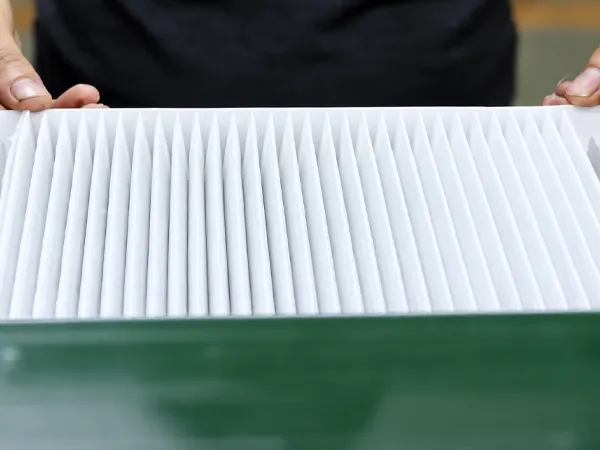
A pleated media pack is not yet a finished cabin filter. It still requires the support structure defined by the product design. Some filters use edge strips on two opposite sides, while others require a complete four-side perimeter. This difference affects pack positioning, corner formation, final dimensional control, and the next assembly or installation step.
Equipment selection should therefore begin with the finished filter rather than a machine list. Two-side and four-side bonding are different production routes, and neither is inherently better. The suitable route is the one that consistently produces the specified filter with practical changeover and staffing requirements.
Let the Finished Filter Structure Determine the Route
A filter with two-side edge support receives edge material on two opposing sides, while the remaining sides follow the product design. The bonded edges help maintain the pleated pack at the specified width and provide the support required for the next operation or final installation. Before bonding, the pack must already have controlled pleat count, height, cut length, and edge condition, since bonding cannot correct an unstable pack.
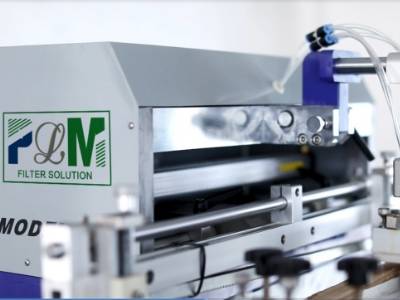
The PLM-TB-2 page lists a reference product range of 150–400 mm in length, 150–300 mm in width, and 10–60 mm in height, with a scraping width of 10–60 mm. These parameters are useful for initial screening but do not replace sample confirmation. Edge-strip material, adhesive behavior, pleat recovery, locating references, and required finished dimensions must still be evaluated together. The key question is whether the approved filter uses two opposite supporting edges or requires a complete surrounding frame. Front and back views, overall dimensions, and edge details are more useful than a front photo alone before equipment selection.
Four-Side Bonding Requires Corner, Positioning, and Trimming Control
A four-side filter requires a continuous perimeter, so the process must control each side and the corner transitions. Each side must meet the target length and position, the corners must match the approved sample, and excess material or adhesive must be handled without affecting finished dimensions or damaging the media.
Inspection should focus on the completed frame, including overall length, width, and height, frame shape, corner appearance, edge position, bond continuity, and visible media damage. These are manufacturing checks for the agreed product and should not be treated as proof of filtration performance, which still requires the customer’s specified validation method.
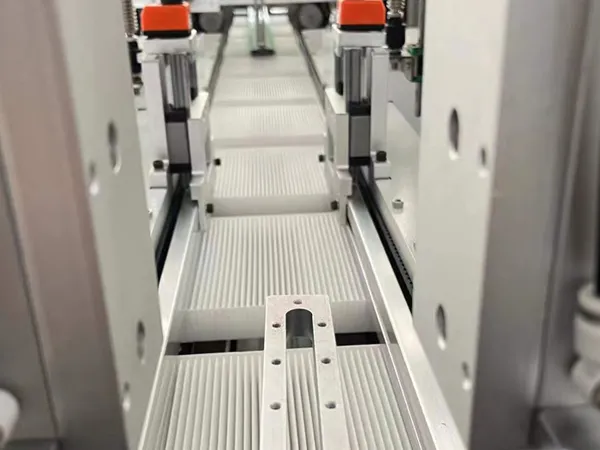
We offer more than one four-side configuration. The PLM-TB-4 page describes a multi-station production line with a published footprint of 19,000 × 3,000 × 2,000 mm. PLM-TB-4S is another four-side bonding option. Its applicable dimensions, operating mode, and layout should be confirmed against the current data sheet and the customer’s filter sample. This shows that four-side bonding does not refer to one fixed equipment layout.
Product Mix and Changeover Matter More Than Speed
Published machine pages may use different cycle-time definitions. One may report the action time of a single equipment group, while another may state seconds per finished piece. These figures should not be compared directly unless they are measured on the same basis. Production planning should consider the complete process, including loading, positioning, corner work, trimming, inspection, and model changeover.
A factory producing a small number of stable models may prioritize continuous transfer and a fixed production rhythm. A factory handling more sizes and shorter batches may place greater emphasis on tooling changes, recipe recovery, first-piece approval, and operator access. Available floor space and the condition of incoming pleated packs also affect whether a compact machine, staged arrangement, or longer integrated line is practical.
Before comparing equipment, define:
- Finished-filter structure, dimensions, and acceptable corner and trimming appearance.
- Media, edge-strip, and hot-melt adhesive types, with representative samples.
- SKU count, size range, normal batch length, and expected changeover frequency.
- Target output, available operators, workshop space, and utilities.
- Existing pleating or bonding equipment and the current bottleneck.
Match the Bonding Route to the Actual Filter
We can review the PLM-TB-2 for two-side support and the PLM-TB-4 or PLM-TB-4S for four-side structures. A staged option is also available: the PLM-TB-2-4 uses two double-side units to process all four edges and includes corner trimming. This provides another four-side route when the product mix, layout, or preferred operating method does not suit a full continuous line.
Machine choice is only one part of the review. Edge-strip preparation, hot-melt adhesive, tooling, pack positioning, and first-piece checks must all match the approved filter. For an existing factory, suitable equipment can be retained while the actual bottleneck is addressed. For a new line, space, material flow, utilities, operator access, and future expansion should be considered before the final configuration is fixed.
Start with Your Filter Sample and Production Requirements
A practical review begins with the customer’s filter. We can use samples and drawings to identify the bonding structure, confirm the size and material range, and, where applicable, coordinate sample trials before defining the equipment, tooling, and operating conditions.
The route review focuses on four checkpoints:
- Identify the finished edge structure from the sample or drawing.
- Match the media, edge strip, adhesive, and tooling.
- Confirm sample results, first-piece criteria, and changeover requirements.
- Finalize layout, operators, utilities, installation, and training needs.
For an initial review, provide:
- Front and back photos, or a finished-filter sample.
- Length, width, and height, plus edge and corner details.
- Media, edge-strip, and adhesive information.
- Planned models, target output, available workers, and current equipment.
The right bonding solution is the one that matches the finished structure and the factory’s actual product mix.