Cabin Air Filter Production from Media to Finished Filter
A consistent pleat pattern is an important starting point in cabin air filter production, but it does not define a finished filter. The pleated media must also meet the required dimensions, edge support and installation fit. Each operation should therefore prepare a suitable component for the next stage rather than function as an isolated process.
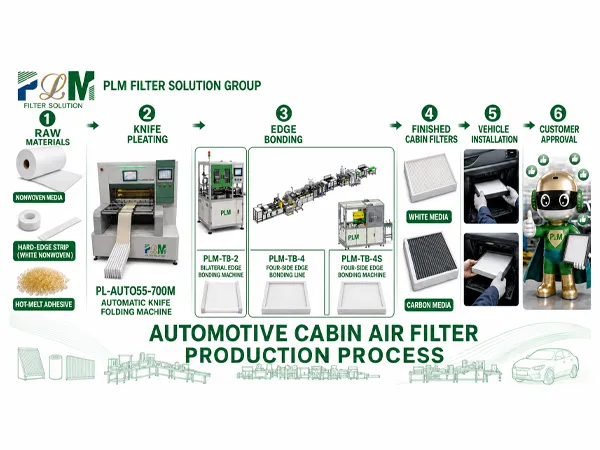
The process then moves through six stages: raw materials, knife pleating, edge bonding, finished filters, vehicle installation and customer approval. These stages do not represent six machines in a fixed production line. The final stages relate to the product and its application, while cutting, trimming, marking and conveying are configured within the production route as required.
Define the Finished Filter Before Selecting the Process
Product definition should begin with a sample or drawing that specifies the finished dimensions, media type and edge structure. A two-side-supported pleated pack and a filter with a complete four-side perimeter may require different downstream arrangements, while irregular shapes may also require different cutting operations from rectangular products. Nonwoven and activated-carbon filter media, hard-edge strips and hot-melt adhesive should therefore be considered together. Media thickness, stiffness, powder release and bonding behavior should be verified with samples before confirming whether one configuration can handle both white-media and activated-carbon products.
The outcome of this stage should be a defined product specification covering the finished form, materials and support structure. This provides a clear basis for equipment selection and reduces the risk of identifying an incompatible edge structure only after the pleating machine has been selected.
Pleat and Cut the Media for the Next Operation
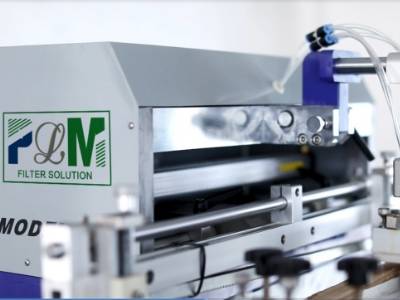
The pleating stage converts flat media into a functional filter pack. Pleat height, spacing and count must match the target pack dimensions, and the pack should be assessed as it enters the bonding station rather than only by the appearance of the folds leaving the pleater. PLM's cabin filter solution includes the PL-AUTO55-700M automatic knife folding machine with adjustable feeding, folding and temperature settings. These parameters can be matched to the selected media and product, but the machine's adjustment range does not replace verification with the actual material and sample.
The process may also include media cutting, special-shaped cutting and edge-material cutting, depending on the filter design and line configuration. Before bonding, checks should confirm pack dimensions, pleat count, edge condition and fit with the intended tooling. A correctly sized, stable pack provides a consistent starting point for bonding.
Bond the Edges and Confirm the Finished Filter
Edge bonding provides the support structure required by the filter design. Two-side bonding supports opposite sides of the pleated pack, while four-side bonding creates a complete perimeter and requires control of the corners, edge positioning and trimming. These are alternative routes selected according to the product design, not sequential operations. PLM offers the PLM-TB-2 bilateral bonding machine and the PLM-TB-4 and PLM-TB-4S four-side bonding solutions. Equipment selection should consider product dimensions, model range, tooling, available operators and the target level of automation. The PLM-TB-4, for example, coordinates feeding and edge application, making the condition and positioning of the incoming pack important to the bonding process.
After bonding and any required trimming, inspection focuses on the finished filter, including dimensions, frame shape, edge adhesion and visible damage. Installation confirmation verifies the fit in the intended housing and the specified airflow direction. These checks are part of product validation and should not be presented as proof of filtration performance. Any performance or acceptance requirements should be defined for the specific filter, with an approved sample, drawing and agreed inspection criteria serving as the reference for customer confirmation and subsequent production.
Turn the Process into a Workable Production Plan
Once the product and process route are defined, the pleating and bonding equipment can be matched with the required cutting operations, materials and tooling. The plan should also account for station-to-station transfer, operator and maintenance access, and available workshop space. For an existing factory, planning should begin with the current process and its main constraint, retaining suitable equipment while improving specific operations. A new project requires the complete production route to be defined from the outset. In either case, the configuration should reflect the actual product range and production target rather than include every available machine.
PLM's support includes installation guidance, online and factory training, maintenance guidance and spare parts. This support extends beyond machine selection to controller operation, daily upkeep and troubleshooting, helping the local team run the agreed process effectively.
Start with the Filter You Plan to Produce
A complete cabin filter line depends on effective handovers between stages: suitable media becomes a controlled pleated pack, the pack receives the required edge structure, and the finished filter is checked against its intended use. These handovers connect individual machines with the customer's actual production requirements.
For an initial production review, please provide:
- Finished-filter photos or drawings, dimensions and edge structure;
- Media and edge-strip types, with representative samples where available;
- Target output, planned models and available operators;
- Workshop conditions, existing equipment and the main production difficulty.
Share the filter dimensions, media, edge structure and target output with PLM. We can help review the process route and recommend a suitable direction for equipment, materials and tooling.